

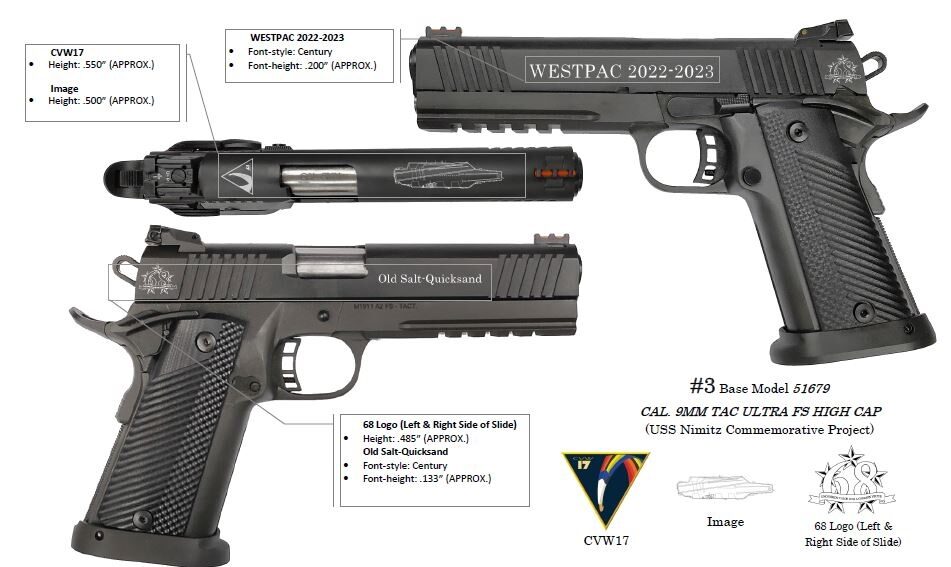
Rock Island Armory Tac Ultra
The USS Nimitz (CVN-68) is the lead ship of the Nimitz-class nuclear-powered aircraft carriers. Her keel was laid at Newport News Shipbuilding in Virginia on June 22, 1968, she was launched in 1972, and she was commissioned at Naval Station Norfolk on May 3, 1975. At the time, she represented a major advancement in American naval power: a nuclear-powered carrier capable of remaining at sea for extended periods while operating a large embarked air wing.
The ship is named for Fleet Admiral Chester W. Nimitz, one of the most important American naval commanders of World War II. As Commander in Chief of the U.S. Pacific Fleet and Pacific Ocean Areas, Nimitz directed enormous Allied naval, air, and ground forces during the Pacific War. He oversaw the transition from the defensive phase of the war to the major American offensives that ultimately led to victory over Japan.
Nimitz also had a major influence on naval technology and strategy. He was an early submarine expert, helped develop underway replenishment techniques that allowed fleets to remain at sea for long periods, and later played a role in the development of nuclear-powered submarines. After World War II, he served as Chief of Naval Operations from 1945–1947 and was the last U.S. officer to hold the five-star rank of Fleet Admiral.
Service history
Nimitz’s first deployment began in 1976, when she sailed from Norfolk to the Mediterranean. Over the following decades, the carrier became a regular presence in some of the world’s most strategically important waters.
One of the earliest defining moments in the ship’s history came in 1979–1980, when Nimitz was sent to the Indian Ocean following the Iranian hostage crisis. In April 1980, helicopters operating from Nimitz participated in Operation Eagle Claw, the attempt to rescue the American hostages held in Tehran. The mission was ultimately aborted in the Iranian desert after mechanical failures reduced the number of available helicopters below the required minimum.
Nimitz later participated in Operation Earnest Will, protecting Kuwaiti oil tankers during the Iran-Iraq War, and deployed in support of Operation Desert Storm in 1991. She subsequently supported Operation Southern Watch, enforcing the no-fly zone over Iraq.
The carrier continued its operational history into the post-Cold War era, conducting deployments in support of Operation Enduring Freedom in Afghanistan and Operation Iraqi Freedom. Nimitz also participated in Operation Inherent Resolve, the international campaign against ISIS.
In 2014, Nimitz made naval aviation history when an F-35 Lightning II conducted the first at-sea carrier landing of the Navy’s fifth-generation Joint Strike Fighter.
The 2020–2021 deployment
One of Nimitz’s most remarkable modern deployments occurred during the COVID-19 pandemic.
Beginning in July 2020, the carrier operated for approximately 341 consecutive days, making it one of the longest carrier deployments since World War II. Despite the extraordinary circumstances created by the pandemic, Nimitz and her crew continued conducting operations in the U.S. 5th and 7th Fleet areas.
That deployment demonstrated something central to the carrier’s identity: the ability to maintain combat readiness and project American naval power even under exceptionally difficult circumstances.
Recent history
Nimitz returned to sea again in November 2022, conducting a deployment that covered more than 65,000 nautical miles. During that cruise, on April 22, 2023, the ship recorded its 350,000th arrested aircraft landing, the most of any aircraft carrier.
In 2026, Nimitz undertook what has become another significant chapter in her history. She deployed to the U.S. Southern Command area of operations as part of Southern Seas 2026, operating with partner nations and participating in multinational maritime activities. She returned to the United States in June and subsequently arrived at Naval Station Norfolk in July 2026, marking a new homeport chapter for the ship.
Mission
The official mission of USS Nimitz is to conduct carrier air warfare operations and assist in the planning, control, coordination, and integration of air wing squadrons in support of carrier air warfare.
In practical terms, Nimitz serves as a mobile, sea-based airfield and command center. Her nuclear propulsion allows her to remain at sea for extended periods, while her embarked aircraft provide capabilities including:
- Air superiority and fleet defense
- Precision strike
- Maritime security
- Intelligence, surveillance, and reconnaissance
- Protection of carrier and expeditionary forces
- Support for joint and coalition operations
- Humanitarian assistance and disaster response
The carrier’s real strength isn’t simply the ship itself. It is the integrated carrier strike group—the carrier, its aircraft, escorts, logistics vessels, and thousands of Sailors and aircrew working together as a single fighting force.
Legacy and identity
The name Nimitz carries an unusually powerful meaning in the U.S. Navy. Fleet Admiral Nimitz was known not only for his strategic leadership, but for his calm, professional approach to command and his ability to coordinate enormous forces across an immense theater of war.
The ship bearing his name has carried that legacy forward for more than five decades.
From the Iranian hostage crisis and Operation Eagle Claw, through Desert Storm, Southern Watch, Enduring Freedom, Iraqi Freedom, Inherent Resolve, and the carrier’s modern Indo-Pacific and Southern Hemisphere deployments, Nimitz has repeatedly demonstrated the ability to project American air power across the globe.
In short: USS Nimitz is more than the lead ship of a class of nuclear aircraft carriers. She represents a bridge between the strategic vision of Fleet Admiral Chester W. Nimitz and the modern concept of American global naval power. For more than 50 years, her mission has remained fundamentally consistent: maintain a powerful naval air capability, protect the fleet, deter aggression, and project American power wherever she is needed.
The Navy’s own historical material describes Nimitz as the oldest American aircraft carrier still in active service, making her longevity and operational record a significant part of her legacy.